Many home renovations are already unsuccessful even before you decide on a single paint color. It’s not an issue of style per se – it’s an issue of process. Most people are guided by aesthetics first, picking out what they like first, trying to make a functional plan work with them, and estimating the practical costs of their luxury choices later (which is perhaps analogous to trying on shoes after you’ve bought them.)
The Invisible Architecture of a Well-designed Room
Space planning is what happens before you see the room. It defines where you’ll stand, how you’ll move, and if the space will still feel roomy (or conversely, feel too cramped) three years after the room is done and you’ve grown used to it.
Professionals build detailed, scale drawings in 2D and 3D using CAD software. They do it before anything gets ordered because scale and proportion often aren’t what most people assume – a sofa that looks perfect in a showroom ad can completely overpower real space if the ceilings and walls it’s sitting next to don’t match the visual weight of the piece. A dining table that seats eight means nothing if the chairs have to bump into the wall when people are sitting in them.
The most important part of a good space plan is the clearance zone. These invisible spaces are what separate the functional walkway in a kitchen from a wasted wall, or a desk that can be easily used from one that requires you to scrape the wall every time you’re getting in and out. Professionals make them part of the plan. Most people realize they’ve forgotten to account for them only after they’ve started nudging the chair every meal.
The Technical Side Most People Skip
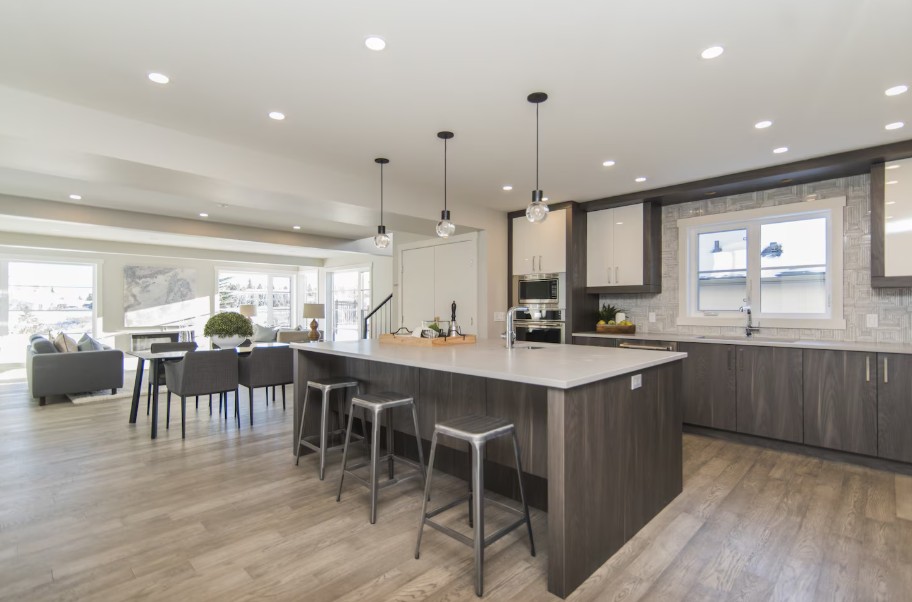
The kitchen work triangle’s been part of kitchen design for ages and it still works. It’s a concept that describes the relationship between the fridge, sink, stove – the roughly three points of most-frequent-daily-use – and says the total distance between them works best falling within a range. It’s ergonomics, or designing around how people actually move, not how designers dream they might.
Local smarts refine this; a Modern interior designer Calgary homeowners work with knows how to balance a desire for open, light-flooded space with the real need for small, warm, insulated islands in a sea of prolonged cold temperatures. Not a problem you’re going to find in a generic ‘how-to’ design book.
The adjacency matrix (a fancy term for something simple) plots which rooms or functions need to be near each other. A home office near a noisy kitchen isn’t going to work for you or your clients. Neither is a mudroom that doesn’t connect to any of the logical entry points of the home. These things get decided early on, not early enough after the hammering’s done.
How a Good Plan Makes Rooms Feel Larger
Space planning may sound like an unnecessary indulgence for people with huge funds to blow, but it’s also one of the cheapest tools in the box for adding the illusion of space. Ironically, considering adding negative space is the easiest way to conjure up more room, no contractors or electricians required.
Squishing every bit of your two largest pieces of furniture against opposite walls might not be the best approach. Think about how a room feels bigger when you remove a painting or wall hanging. Your eye has somewhere to rest. Professionals let the room breathe. The same concept works here, except it happens on purpose. Pulling a sofa away from the wall by even a few inches, or choosing a smaller coffee table that leaves more floor visible, can trick the eye into reading the space as larger than it actually is. It costs nothing, takes minutes, and the difference can be surprising.
Function is What Buyers Are Actually Paying For
Effective planning finds storage in places that aren’t obvious: underutilized corners turned into millwork, awkward alcoves converted into built-in shelving, dead wall space above doorways put to use. None of this requires square footage. It requires someone who looks at a floor plan and sees what’s missing.
A lighting plan follows the same logic. Ambient, task, and accent lighting aren’t just aesthetic layers – they’re functional decisions that depend on where furniture is placed and how the room is used at different times of day. The layout determines the lighting. The lighting doesn’t get retrofitted around whatever furniture happened to fit.
The Investment Case is Straightforward
A well-designed house has a higher value, provides a better lifestyle, and does not need a second round of renovations to correct mistakes from the first renovation. Space planning should not be considered an optional extra when it comes to renovation – it is the aspect that will determine the success of the renovation. Most homeowners do not recognize that this should be the first step, even before ordering anything else.